Roman historians recorded Emperor Claudius's British campaign of 43 AD reaching a symbolic conclusion in the following years as tribal resistance in the south was subdued and Camulodunum (Colchester) was established as a colonia. The conquest reshaped Britain's political landscape for nearly four centuries, introducing roads, towns, and Latin administration.

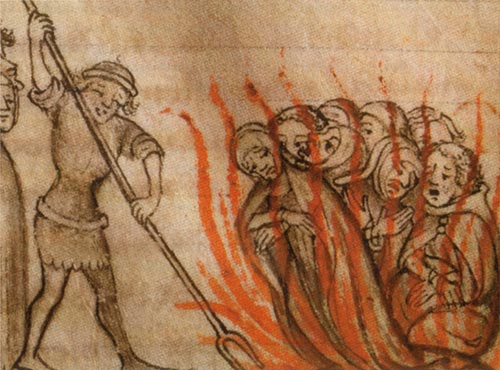
Acting on secret orders sealed weeks earlier, royal officers throughout France seized Templar knights simultaneously at dawn, charging them with heresy, blasphemy, and corruption. Deeply in debt to the order and eager to seize its wealth, Philip IV moved with a coordination remarkable for the era, catching most Templars completely by surprise.
By 1307, the once-unified Mongol Empire had splintered into competing khanates that had spent decades at war with one another. A general peace, negotiated in the early 1300s, allowed trade routes across Eurasia to reopen and diplomatic missions to flow between courts from Beijing to Tabriz to the Volga steppe.

A day after landing at Guanahani, Columbus recorded detailed observations of the Lucayan people, describing their canoes, body paint, and eagerness to trade cotton and spears for glass beads and metal bells. His journal entries, brimming with plans to convert and later enslave the islanders, marked the opening chapter of prolonged European contact with the Americas.

Following his October 12 landfall on an island he named San Salvador, Columbus spent the following days sailing among the Bahamas, encountering the Lucayan people and recording observations in his journal that would shape European understanding—and misunderstanding—of the Americas for generations.
Combined American and French forces under George Washington and the Comte de Rochambeau pressed their siege of Yorktown, digging a second parallel trench line ever closer to British fortifications. The relentless bombardment, combined with a French naval blockade preventing British evacuation or reinforcement, doomed Cornwallis's army and effectively decided the American Revolutionary War.

Dragged before a hostile tribunal, Marie Antoinette faced accusations ranging from squandering the treasury to conspiring with foreign powers against revolutionary France. The trial, conducted with predetermined outcome, reflected the Terror's logic that the monarchy itself was a crime deserving death. She was guillotined two days later.

Established to convert the flood of gold pouring from California's mines into standardized currency, the San Francisco Mint solved a critical problem: miners and merchants had been relying on privately minted, inconsistent gold coins. The federal mint brought stability and trust to a frontier economy transformed almost overnight by 1848's gold discovery.

Following Mussolini's ouster in July and Italy's armistice with the Allies in September, the new Italian government under Marshal Pietro Badoglio declared war on Nazi Germany. The move plunged Italy into a brutal internal conflict, as German forces occupying the north fought both Allied troops and Italian partisans for the remainder of the war.

Launched in August 1962, Mariner 2 performed a carefully calculated engine burn on its way to Venus, fine-tuning a trajectory that would carry it past the planet in December. The maneuver, among the first of its kind, proved that spacecraft could be steered across millions of miles of empty space toward a precise rendezvous with another world.

Days after Bolivian forces captured and executed Che Guevara on October 9 in La Higuera, photographs and reports confirming his death spread internationally around this time, sparking outrage among leftist movements worldwide and beginning his posthumous transformation into one of the twentieth century's most reproduced revolutionary icons.
The Norwegian Nobel Committee honored Sadat and Begin for their historic negotiations, brokered by U.S. President Jimmy Carter at Camp David weeks earlier, which laid groundwork for the 1979 Egypt-Israel Peace Treaty. The award recognized a diplomatic breakthrough between two nations that had fought four wars in three decades.

Hours after a bomb tore through the Grand Hotel, killing five and narrowly missing the Prime Minister's suite, Thatcher opened the Conservative conference declaring that the attack had failed 'because we are gathered here now, shocked but composed and determined.' Her defiance became one of the defining moments of her premiership and of Britain's response to IRA terrorism.

A specially designed capsule named Fénix 2 hauled the final miner, shift foreman Luis Urzúa, to the surface just before midnight, completing a rescue operation that had gripped global attention since the mine's collapse in August. All 33 men survived the ordeal, the longest underground survival in mining history at the time.

Sixty-nine days after a rockfall trapped 33 men nearly half a mile underground, rescuers completed a painstaking extraction using a narrow capsule threaded through a borehole. Urzúa, the crew's shift supervisor who had organized survival efforts below, emerged last to applause from Chile's president and a global television audience of over a billion people.
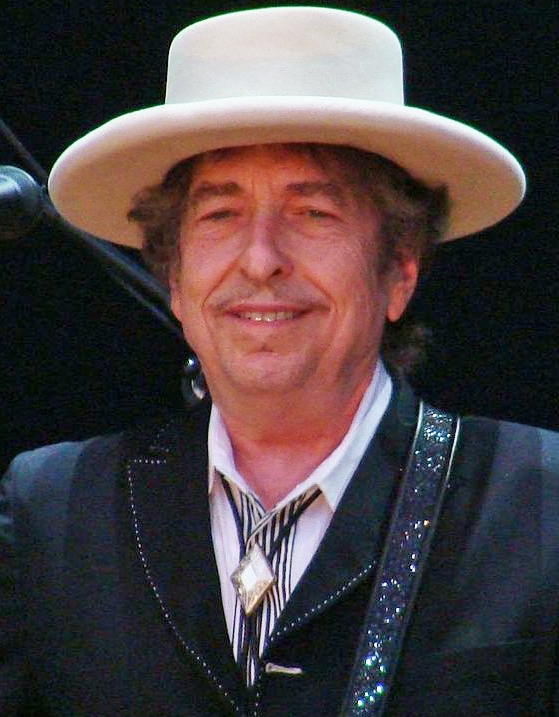
For the first time, the Nobel committee recognized a songwriter for the literature prize, sparking fierce debate over whether song lyrics qualified as literary art. Dylan, characteristically elusive, did not respond publicly for weeks and skipped the Stockholm ceremony, sending Patti Smith to perform 'A Hard Rain's A-Gonna Fall' in his place.