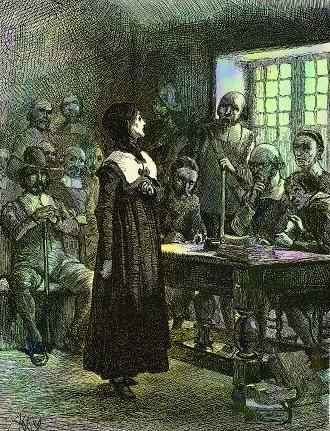
Anne Hutchinson, a midwife and religious dissenter exiled from the Massachusetts Bay Colony for her unorthodox preaching, was killed on October 10, 1643, when Siwanoy warriors attacked her settlement near present-day Pelham Bay in New York, part of retaliatory violence during Kieft's War. Only one of her children survived. Her earlier trial had made her an early symbol of religious liberty and resistance to Puritan patriarchal authority.
Giuseppe Verdi was born on October 10, 1813, in the hamlet of Le Roncole in the Duchy of Parma. Rising from a humble innkeeper's family, he became the dominant composer of Italian opera in the 19th century, writing masterpieces including Rigoletto, La Traviata, and Aida, and his music became entwined with the Italian unification movement itself.

On October 10, 1868, Cuban planter Carlos Manuel de Céspedes freed his slaves and issued the Grito de Yara, calling for Cuba's independence from Spain. The uprising spread quickly across Oriente province, launching the Ten Years' War, a bloody conflict that failed to win independence but planted the seeds for the eventual Cuban war of 1895 and shaped the island's national identity.

Greek sponge divers exploring a shipwreck off the island of Antikythera recovered a corroded bronze mechanism in 1901 that archaeologists initially catalogued without recognizing its significance. Decades of study revealed it to be an extraordinarily sophisticated geared device, likely built around 100 BC, capable of predicting eclipses and tracking planetary positions, a level of engineering unmatched for over a millennium afterward.
A bomb accidentally detonated in a revolutionary cell's hideout in Hankou on October 9, 1911, forcing conspirators to act early. On October 10, soldiers of the New Army mutinied in Wuchang, seizing the city and raising the flag of revolt. The uprising cascaded across provinces, and within months the Qing dynasty abdicated, ending 2,000 years of dynastic rule and giving birth to the Republic of China.
The 1964 Summer Olympics opened in Tokyo on October 10, marking the first time the Games were held in Asia and serving as a global symbol of Japan's dramatic postwar reconstruction. The opening ceremony featured runner Yoshinori Sakai, born in Hiroshima on the day the atomic bomb fell, carrying the Olympic torch, a deliberate and poignant gesture of national renewal.
On October 10, 1970, exactly 96 years after being ceded to Britain in 1874, Fiji became independent, ending nearly a century of colonial administration. The transition preserved a delicate ethnic balance between indigenous Fijians and the descendants of Indian indentured laborers brought to work sugar plantations, a demographic tension that would later erupt in coups but did not overshadow the day's celebrations.

On October 10, 2021, the Soyuz MS-18 capsule landed on the steppes of Kazakhstan, returning cosmonaut Oleg Novitskiy along with actress Yulia Peresild and director Klim Shipenko after twelve days aboard the International Space Station. The pair had traveled to orbit to shoot scenes for 'Vyzov' ('The Challenge'), the first narrative feature film with scenes actually filmed in space, narrowly beating a competing Tom Cruise project.
