According to Burmese chronicles, King Pyinbya fortified the city of Bagan around this year, beginning its transformation into the capital of the Pagan Kingdom. Over the following centuries, Bagan's rulers built thousands of temples across the Irrawaddy plain, creating one of the world's greatest concentrations of Buddhist architecture.

Leibniz's 'Nova Methodus pro Maximis et Minimis' introduced his notation for derivatives, laying groundwork for modern calculus independently of Newton's earlier but unpublished work. The rival claims of invention sparked a bitter, decades-long controversy between British and continental mathematicians that shaped the development of European science.

As part of the Spanish-American War, the USS Charleston sailed into Guam's harbor and fired on the old Spanish fort, only to discover the Spanish governor had no idea war had broken out and possessed no ammunition to return fire. The bloodless capture placed Guam under American control, where it remains a U.S. territory today.

Engineers continued studying wind-induced aerodynamic instability in long-span bridges throughout the 1950s, following the notorious 1940 Tacoma Narrows collapse. Continued monitoring and redesign efforts through this period fundamentally changed how engineers modeled wind loads on suspension bridges worldwide.

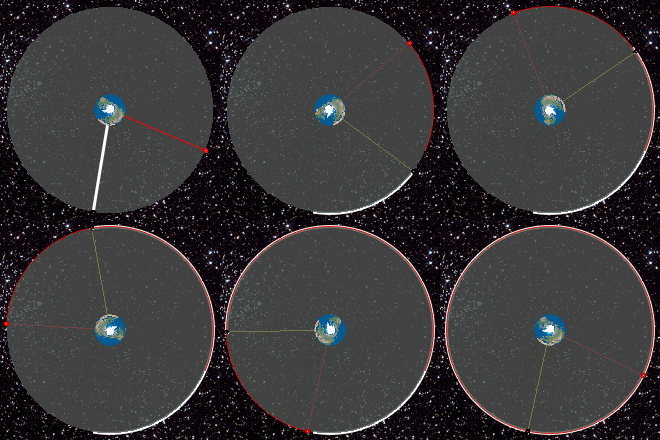
Unlike its predecessor Telstar, which orbited too quickly for continuous coverage, Syncom 2 matched Earth's rotation, allowing it to hover over a fixed longitude. Its success proved the viability of geosynchronous satellites, paving the way for the global communications and broadcast infrastructure that followed.
At the climax of the March on Washington for Jobs and Freedom, King departed from his prepared text and delivered the extemporaneous 'I Have a Dream' refrain, drawing on biblical cadence and American founding ideals. The speech became the emotional center of the civil rights movement and helped build momentum for the Civil Rights Act of 1964.

After three days of standoff in which Boris Yeltsin rallied resistance from atop a tank outside the Russian parliament, the coup plotters who had detained Gorbachev lost military backing and surrendered. The failed putsch discredited the Communist Party and accelerated the breakup of the USSR, which formally dissolved four months later.
